







 Beyond The Bike: Giving Every Honda Its Own Unique Voice
When riders talk about a motorcycle’s “character,” they are rarely referring to a single measurable attribute. It’s not just horsepower, torque figures, or lap times. It’s the feeling, the connection, and often the sound that imprints itself on memory. According to Takatoshi Tatsumi, an NVH (Noise, Vibration and Harshness) specialist deeply involved in Honda’s engine development, this elusive character begins at the most fundamental level.
From an acoustic standpoint, engine character is born at the moment of combustion. Tatsumi‑San explains that what riders perceive first is “the sensation of combustion at the intake interval,” a feeling that sets expectations for how the engine will behave as revs rise and fall. The intake interval being the moment within the engine, that the crankshaft rotates moving the piston from its upmost position to the bottom of its cycle, and as the intake valves open.
Technically, this is what he refers to as “pulse sensation” – a phenomenon that cannot be artificially created. “It is difficult to create the source of this pulse sensation through anything other than engine combustion,” he notes, underscoring the idea that authentic character must originate from the engine itself, not from cosmetic or electronic additions.
That philosophy has a profound impact on development. Contrary to the idea that engineers simply bolt on different exhausts until the right sound appears, Tatsumi‑San makes it clear that sound creation is never isolated from the broader vehicle concept. Exhaust prototypes are not built solely to chase tone; they are developed alongside considerations such as “power output, drivability, design and road feel.”
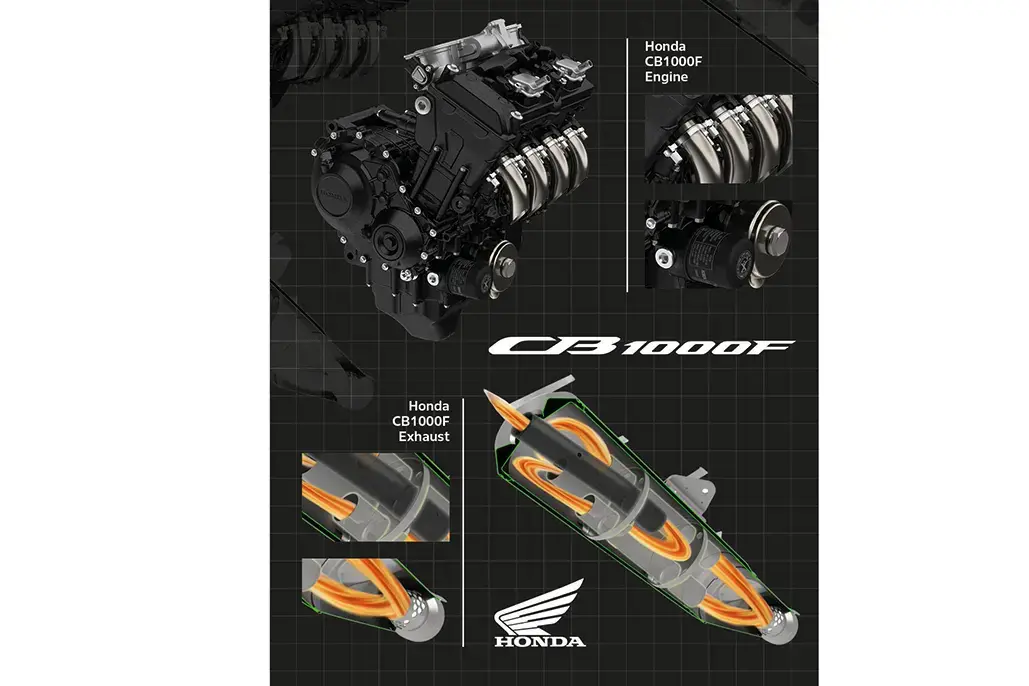 The scale of experimentation, however, may still surprise. During development of the CB750 Hornet, Tatsumi‑San recalls that “we tried nearly a hundred different patterns just to test the sound.” Each iteration represents a small adjustment, a different internal structure, frequency response, or interaction with the engine’s combustion characteristics. Gradually narrowing toward a sound that accurately reflects the overall machine concept.
Modern development relies heavily on digital simulation, and engine acoustics are no exception. Honda models and analyses sound characteristics digitally before any physical prototype is produced. The accuracy of these tools has improved dramatically, allowing engineers to explore acoustic behaviour early in the process. Yet, as Tatsumi‑San is quick to point out, digital analysis has limits.
“There are still aspects that cannot be determined without testing on the actual machine,” he says. This is where human perception remains irreplaceable. While frequency, volume, and response can be measured and graphed, the final judgement does not come from a screen. “Ultimately, we make the decision based on human perception,” Tatsumi‑San explains. Sound must embody not only a target decibel level, but the product concept as a whole; how the motorcycle feels as a vehicle, not just how it sounds in isolation.
This human-centric approach extends beyond the rider alone. Honda evaluates sound both “at the rider’s ear” and as perceived by third parties – those standing roadside or sharing urban environments. Engineers analyse frequency, volume, throttle response and the subtle “nuances of sound variation” that distinguish one engine from another.
Interestingly, inspiration does not come from music or nature, at least not consciously. Tatsumi‑San admits that, in his experience, engine acoustics are developed through engineering logic rather than emotional references. The artistry lies not in imitation, but in refinement – extracting the most desirable elements of combustion and suppressing everything else.
One of the most enlightening insights from Tatsumi‑San is just how early sound development begins. For new engines, NVH specialists are involved from the specification stage itself. As soon as discussions turn to ignition timing or valve timing – core elements of combustion behaviour – sound and feel are already being shaped.
This early involvement reflects a broader truth: sound cannot be treated as an afterthought. Once the fundamental combustion characteristics are set, the range of achievable engine personalities becomes fixed. The exhaust may emphasize or soften certain traits, but it cannot invent them.
That reality forces difficult prioritisation. Sound, after all, is subjective. “Sound is a sensory evaluation, so setting targets can be challenging,” Tatsumi‑San explains. Some models demand strict adherence to numerical performance goals, while others allow more freedom to pursue emotional appeal. In every case, the balance is decided through careful discussion, guided by the concept of each motorcycle rather than a universal rule.
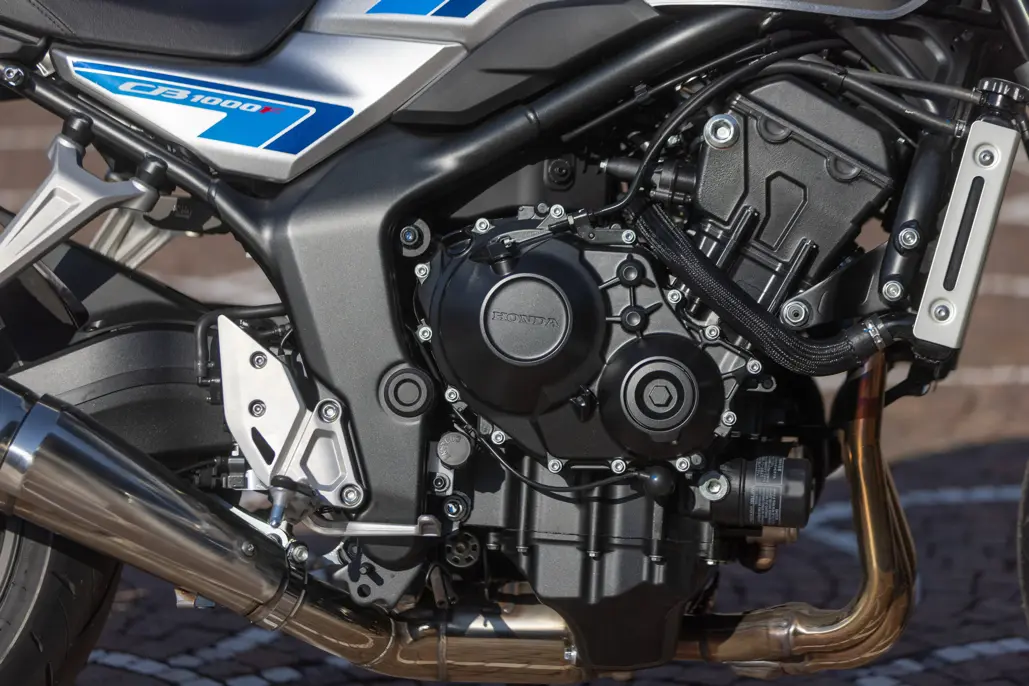
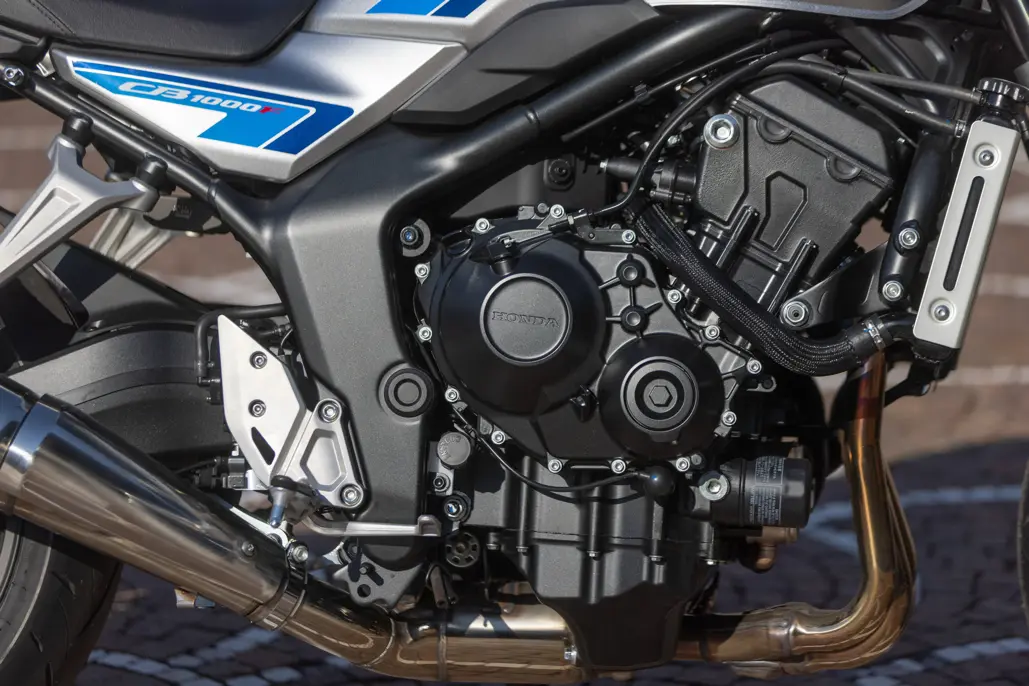
This principle becomes even more important when a single base engine underpins multiple models. Tatsumi‑San points to differences between machines such as the CB1000F and the Hornet, where cam specifications are altered to reshape combustion characteristics. One leans toward a “rumbling low-end feel,” while the other delivers “a sporty, high-frequency revving sensation.” With the scope for internal changes to the engine limited, the exhaust system becomes a powerful tool for differentiation, helping each model express its own identity.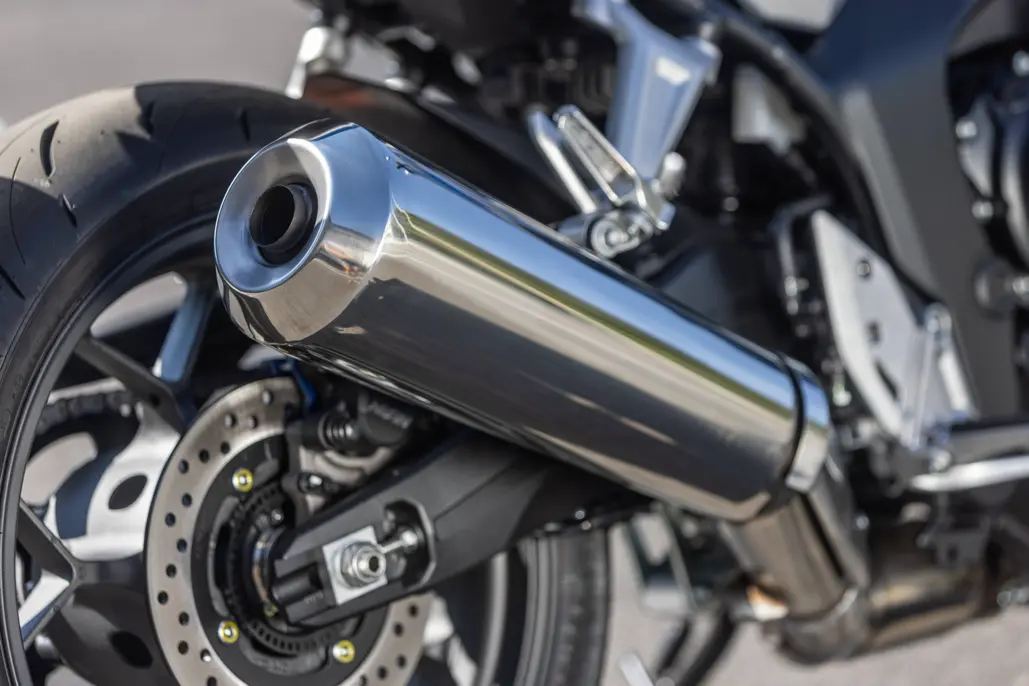
That is achieved through intricate engineering work within the engine. The CB1000F utilizes different width intake runners across its four cylinders (cylinders 1 and 2 use a 50mm intake, whilst 3 and 4 use a 40mm intake). This is paired with a 17-degree offset in valve timing to create a unique ‘heartbeat’ sound wave for the engine, all from internal components.
Despite its visual and emotional prominence, the exhaust’s role is often misunderstood. “Fundamentally, the exhaust serves as a silencer,” Tatsumi‑San explains. Its job is not to create sound, but to remove what engineers don’t want. By selectively attenuating certain frequencies, often reducing low frequencies while preserving higher ones, engineers can highlight the character already present in combustion.
Design details can further shape perception. A directional tailpipe may aim sound toward the rider (like on the CB125R), or even leverage road reverberations. Yet every choice has consequences, influencing not just acoustics but the overall vehicle concept. Crucially, Tatsumi‑San reiterates: “It is impossible to create sounds or rhythms via the exhaust that do not exist in the engine combustion process to begin with.”
Even visually distinctive elements, such as the megaphone-style silencer on the CB1000F, follow this logic. While the outer shape may be driven by styling goals, the sound itself is defined by the internal structure and by engine specifications like cam timing. In the CB1000F’s case, Honda deliberately adjusted the exhaust’s frequency response toward the lower end to reinforce its character.
Modern electronic control systems add another layer to the experience, refining throttle response and torque delivery. Yet Tatsumi‑San is clear that electronics are not used to fabricate sound. “We have never relied on electronic control to create sound,” he says. Instead, electronics allow riders to access different facets of the engine’s character more confidently making it possible, for example, to enjoy a more aggressive sound and feel when conditions or riding modes allow.
Asked which engines he is most proud of, Tatsumi‑San points to the CB750 Hornet and XL750 Transalp 750 which arrived for the 2023 season. In both cases, Honda tuned dual tailpipes to different frequencies, creating a pulsating sensation as revs climb – a sound that has resonated strongly with riders. Market reception, it seems, confirmed what careful engineering had already suggested.
In the end, Tatsumi‑San’s insights reveal that engine sound is neither art nor science alone, but a disciplined conversation between the two. True character cannot be added at the end of development: It must be designed into the engine from the very first spark.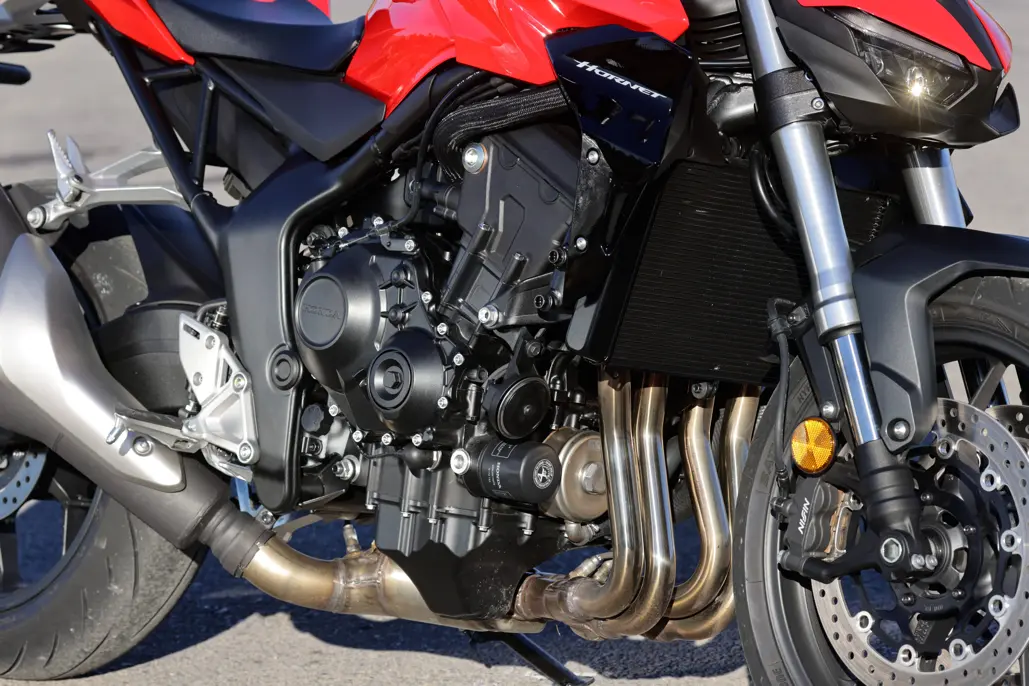
(original post on modernclassicbikes.co.uk)
**************************************
Win Your Dream Motorcycle with Apex66 Competitions: Use our Invitation Code REF3588730 or click the banner below:

**************************************
📣 If you like our video content, please press the ❤️ Hype button on our videos—it might help us grow and reach even more motorcycle enthusiasts. Thank you for your amazing support! 🙌
**************************************
Support Modern Classic Motorcycle News and become a YouTube Member for just £5 per month. Members help keep the channel independent and receive extra value, including x2 digital issues of M.C.M. News Magazine free per month join here:

Out Now on Kindle

Watch, like and subscribe to our Youtube channel
Get These Awesome Perks With Our YouTube Membership!: Join Our YouTube Membership and Save – Get two digital issues of Modern Classic Motorcycle News per month free join here:
👍 Like | 💬 Comment | 🔔 Subscribe for more modern classic motorcycle content
**************************************
For more Honda Motorcycles UK news, check out our dedicated page Honda Motorcycles UK News
or head to the official Honda Motorcycles UK website honda.co.uk/motorcycles.html.
About Honda Motorcycles
Honda is the world’s largest motorcycle manufacturer, founded in 1948 by Soichiro Honda. The company is known for producing reliable, high-quality motorcycles and is the world’s largest manufacturer of internal combustion engines. Honda’s early focus on reliable four-stroke engines and innovative designs, like the highly successful Super Cub, helped it become a global leader in the industry.
Instagram: @hondaukmotorcycles
YouTube: @HondaMotorcyclesEU
Facebook: @HondaMotoUK
* Disclosure: This page may contain affiliate links, which means I may earn a commission (at no cost to you) if you click on the link and make a purchase. Any money made goes straight back into the website and magazine. Your support is appreciated!